
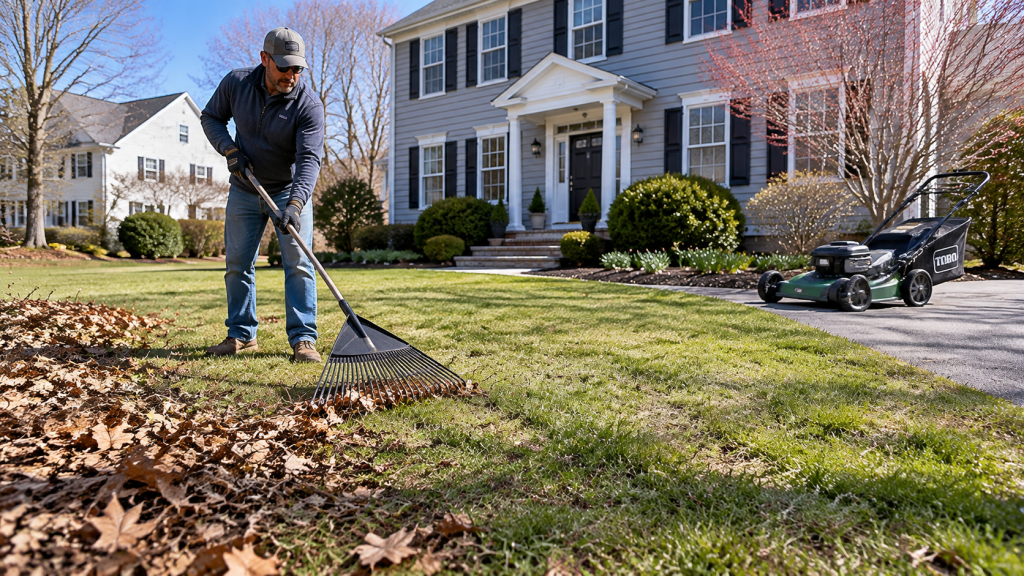
Every Massachusetts spring, the same mistake plays out across thousands of lawns. The first warm weekend hits, homeowners drag out the rake and start pulling up dead grass, then fire up the mower a week later. By the time real growing weather arrives in May, the lawn is thinner, more compacted, and slower to green up than the neighbor who waited.
Spring cleanup in Massachusetts is a timing game more than a work game. Do it too early and you tear up wet turf and expose new shoots to frost damage. Do it too late and matted grass suffocates under debris and snow mold sets in. This guide gives you the exact triggers to watch for, the step-by-step cleanup order, when to do your first mow, and the mistakes that set your lawn back for the whole season.
| Quick answer Start spring cleanup in Massachusetts once the soil has firmed up enough that your footprints do not leave visible impressions (usually late March to mid-April in the Merrimack Valley). Do your first mow when grass is actively growing and reaches 3.5 to 4 inches tall (typically mid to late April). Cut off only the top 1/3 of the grass blade in that first mow. Do not rake wet or matted turf aggressively – light cleanup only until the lawn is fully dried out. |
What you will learn in this guide
- When to START spring cleanup in Massachusetts (soil firmness rule)
- The Massachusetts spring cleanup calendar (week by week)
- The 8-step spring cleanup checklist
- When to do your first mow (grass height + soil trigger)
- The 1/3 mowing rule and why it matters more in spring
- Mower prep: blade, oil, gas, height adjustment
- How to spot and handle snow mold during cleanup
- What NOT to do in early spring (7 common mistakes)
- How cleanup coordinates with pre-emergent, fertilizer, and aeration
- Massachusetts yard waste and composting rules
- Frequently asked questions
When to START spring cleanup in Massachusetts
The single biggest mistake in Massachusetts spring lawn care is starting too early. The first 60-degree Saturday feels like spring, but the ground underneath is still saturated from snow melt and grass crowns are fragile. Walking on wet turf compacts the soil for the entire growing season. Raking wet, matted grass tears out live crowns along with the dead debris.
The three triggers to watch for
- Footprint test. Walk across the lawn. If your footprints leave visible impressions that stay for more than a minute, the soil is still too wet. Wait 3 to 5 more days.
- Grass is showing green. Living grass tissue is bright green at the base. If most of what you see is still winter tan, the grass has not started growing. Cleanup on dormant grass rips out live crowns.
- Overnight temps consistently above 32 degrees F. Frost on freshly exposed crowns damages new growth. Wait until the 10-day forecast shows no hard overnight freeze.
| The 10-minute rule Walk your whole lawn. If you leave footprints, if soil squishes underfoot, or if the grass is still 90 percent tan without visible green at the base, stop and wait a week. Cleanup done on the wrong week undoes half a season of work. |
The Massachusetts spring cleanup calendar (week by week)
These windows are calibrated for Haverhill and the Merrimack Valley. Cape Cod and coastal Boston warm 1 to 2 weeks earlier. Central and western Massachusetts (Worcester, Berkshires) run 1 to 2 weeks later.
| Window | Status | What to do |
| Early March | TOO EARLY | Snow melting, ground saturated. Do nothing on the lawn. Prep tools instead. |
| Mid to late March | PREP WEEK | Sharpen mower blade, change oil, get gas. Assess yard from a distance. Do not walk on wet turf. |
| Late March to early April | LIGHT CLEANUP ONLY | Once ground firms up, pick up sticks, branches, and heavy debris. No raking of grass yet. |
| Mid-April | FULL CLEANUP WINDOW OPENS | Grass showing green at base, soil dried out. Light raking OK. Assess snow mold patches. |
| Mid to late April | FIRST MOW WINDOW | Grass reaches 3.5 to 4 inches. Sharp blade, cut off top 1/3 only. Coordinate with crabgrass pre-emergent. |
| Late April to early May | PRE-EMERGENT + LIME | Apply crabgrass pre-emergent and any lime prescribed by soil test. |
| Mid-May | SPRING FERTILIZER | First fertilizer application of the year. Grass actively growing, weekly mowing. |
| Late May and beyond | REGULAR MAINTENANCE | Weekly mowing at 3 to 3.5 inches. Deep, infrequent watering as needed. |
The 8-step spring lawn cleanup checklist
Do these in order. Skipping steps or doing them out of sequence wastes work and can damage the lawn.
Step 1: Prep your mower before touching the lawn
Sharpen the blade, change the oil, replace the spark plug if needed, and fill with fresh gas. Old gas that sat over winter causes hard starts and can gum up the carburetor. A dull mower blade tears grass instead of cutting cleanly, which browns the tips and increases disease risk. Do this in late March, before the first mow window opens.
Step 2: Pick up debris from a distance
Once the ground is walkable, do a first pass to remove sticks, fallen branches, pinecones, dog toys, and anything else that could damage a mower blade or trip you up. Stay off wet or soft spots. If you leave footprints, come back in a few days.
Step 3: Light raking to lift matted grass
When the lawn has fully dried out (usually mid-April in Haverhill), use a spring-tine rake or plastic leaf rake to gently lift matted grass, especially in areas where snow piled deep. Use short, light strokes. Do NOT use a hard metal rake or aggressive back-and-forth raking – both tear out live grass crowns.
Step 4: Identify snow mold and handle it correctly
Look for circular patches of matted, tan or pink-tinged grass, usually where snow sat longest. Gently rake the matted patches to break up the crust and let air in. Do NOT apply fertilizer to snow mold patches until they green up on their own – nitrogen on damaged crowns slows recovery. Most patches recover within 3 to 4 weeks with just a light raking. See our full guide on how to identify and treat snow mold in Massachusetts for details.
Step 5: Bag leaves and heavy debris
Any leaves that blew in over winter should be bagged or composted. Leaves left on turf during green-up smother new grass and create disease-friendly conditions. Massachusetts yard waste rules vary by town – most have curbside pickup or drop-off during specific weeks in April and May.
Step 6: Fill in small bare spots
Small bare patches (a few square inches to a foot or so across) can be filled with grass seed now if the soil has warmed enough. Rough up the soil surface, apply seed at label rate, top with a thin layer of compost or peat moss, and keep the area lightly moist until germination. Larger bare areas are better addressed with fall aeration and overseeding. Check our best grass seed for Massachusetts guide for species selection.
Step 7: First mow (at the right height)
When grass reaches 3.5 to 4 inches tall and is actively growing, do the first mow. Cut off only the top 1/3 of the grass blade – target height 2.5 to 3 inches for the first cut. Details on the 1/3 rule and mower height are in the sections below.
Step 8: Coordinate with pre-emergent and fertilizer
Once cleanup is done and the first mow is complete, you are in position to apply crabgrass pre-emergent (late April to early May in Massachusetts) and your first fertilizer application (mid-May). Timing all three services in sequence gets the lawn off to a strong start. See our crabgrass preventer timing guide and New England fertilizer schedule for exact timing.
When to do your first mow
The first mow of spring is not driven by the calendar. It is driven by whether the grass is actively growing and tall enough to need cutting. In most Massachusetts years, this hits between mid-April and early May depending on your town.
The three conditions that need to line up
- Grass is actively growing. New growth is visible – bright green at the base of each blade, not dormant tan. If most of the grass is still tan and only the tips look green, wait a week.
- Grass has reached 3.5 to 4 inches tall. If your target mowing height is 3 inches, wait until the grass is at 4 inches (33 percent above target) before the first cut. Cutting shorter grass shocks the plant.
- Soil is firm underfoot. Same test as for cleanup: if you leave footprints or your mower wheels sink in and leave ruts, the soil is still too wet. Come back in a few days.
| Mower height for the first mow Set your mower to the highest setting for the first cut, then step down 1/2 inch every 2 to 3 mows until you reach your summer target. This gradual reduction protects grass crowns and keeps roots from shocking. Most Massachusetts lawns should mow between 3 and 3.5 inches through summer – never below 2.5 inches on cool-season turf. |
The 1/3 mowing rule (and why it matters more in spring)
The rule: never cut off more than 1/3 of the total grass blade height in a single mowing. If your target height is 3 inches, mow when the grass is 4.5 inches (removing 1.5 inches, which is 1/3 of the 4.5-inch total).
The reason: grass photosynthesizes primarily through the blade tissue. Cutting off more than 1/3 removes too much photosynthetic surface at once and forces the plant to burn stored root reserves to regrow. In spring, when the lawn is still building back from winter dormancy, root reserves are already depleted. Scalping in spring is the fastest way to weaken a lawn for the entire growing season.
The 1/3 rule in practice
| Target Mow Height | Mow When Grass Reaches | Best For |
| 3 inches | 4.5 inches | Standard for most Massachusetts KBG/rye/fescue blends |
| 3.5 inches | 5.25 inches | Slightly taller cut – better drought resistance |
| 4 inches | 6 inches | Tallest recommended – best for shaded lawns and fine fescue |
The scalping trap: If grass has gotten longer than the 1/3 rule allows (say it is at 6 inches and your target is 3), do NOT cut all the way down in one pass. Cut off 1/3 (down to 4 inches), then mow again 3 to 4 days later to bring it down further. Two mowings 4 days apart is far better than one aggressive scalp.
Mower prep before the first mow
A well-prepped mower cuts cleanly, starts on the first pull, and runs the whole season without breakdowns. Do this in late March before the first mow window opens.
Blade sharpening
A sharp mower blade cuts grass cleanly. A dull blade tears and shreds it, which browns the tips within a day and creates open wounds where lawn disease enters. Sharpen the blade every year, and mid-season if you mow over debris. Most hardware stores and mower shops will sharpen a blade for $10 to $15. DIY sharpening with a file or grinder works if you already own the tools and know how to keep the balance.
Oil change
Change the oil once a year on 4-stroke mowers (most walk-behind models). Check the manual for capacity and grade. Old oil breaks down and stops protecting the engine. This is a 15-minute job that adds years to the mower.
Fresh gas
Gas that sat over winter (especially ethanol-blend) loses volatility and can gum up the carburetor. Drain any leftover gas or add a stabilizer and run the engine for 5 minutes to circulate. Start each spring with fresh gas.
Spark plug + air filter
Check and replace annually. Both are under $10 parts that fix 80 percent of hard-starting issues. Do it when you change the oil.
Height adjustment
Set the mower to the highest setting for the first mow, then step down as covered in the mow height section above.
What NOT to do in early spring
| DO NOT | Why it damages the lawn |
| Walking on wet or frozen turf | Compacts soil for the entire growing season and can break dormant crowns. Wait for firm, dry ground. |
| Aggressive raking with a metal thatch rake | Tears out live crowns along with dead debris. Use a plastic leaf rake or spring-tine rake with light strokes. |
| Rolling the lawn | Common myth that rolling smooths out heave. It just compacts soil and does nothing for the roots. Skip it. |
| Applying fertilizer to snow mold patches | Nitrogen on damaged crowns slows recovery. Rake gently and let the area recover naturally, then fertilize once it greens up. |
| Early fertilizer (March or April) | Pushes shoot growth at the expense of roots. Wait for the mid-May application per the New England fertilizer schedule. |
| Dethatching in wet spring conditions | Even mechanical dethatching stresses turf. If you need to dethatch, do it once the lawn has fully greened up and dried out, or wait for fall. |
| Scalping the first mow | Cutting short in spring shocks the plant when reserves are lowest. Follow the 1/3 rule and step down gradually. |
How to spot and handle snow mold during cleanup
Snow mold is the most common early-spring lawn issue in Massachusetts. It shows up as circular patches of matted, tan or pink-tinged grass, typically where snow sat deepest or lingered longest. There are two forms:
- Gray snow mold. Tan to gray patches with a whitish crust. Grass usually recovers with light raking to break the crust and let air in.
- Pink snow mold. Same matted patches but with a pink to salmon tint at the edges. More damaging – can kill grass down to the crown. Recovery may require overseeding those areas.
For both types, the treatment is the same in early spring: gently rake the matted grass to break the crust, expose crowns to air and sunlight, and wait 3 to 4 weeks for natural recovery. Do NOT apply fertilizer or fungicide to snow mold patches in early spring – both slow recovery. Fungicide is only useful preventively in late fall, not curatively in spring.
How cleanup coordinates with pre-emergent, fertilizer, and aeration
Cleanup then crabgrass pre-emergent
Finish cleanup and first mow before applying crabgrass pre-emergent. The pre-emergent forms a chemical barrier in the top 1/2 inch of soil that stops crabgrass from germinating. Raking, dethatching, or aerating after application breaks the barrier. Standard Massachusetts sequence: cleanup and first mow in mid-April, pre-emergent in late April to early May. See when to apply crabgrass preventer in Massachusetts for full timing.
First fertilizer after cleanup and first mow
Apply your first fertilizer of the year in mid-May, around Memorial Day – after cleanup, first mow, and pre-emergent are all done. Skip the “early spring wake up” fertilizer bags pushed by retailers in March and April – they push top growth at the expense of roots. Full sequence in the New England lawn fertilizer schedule.
Aeration in spring? Usually skip
For most Massachusetts lawns, fall is the right window for core aeration. Spring aeration is only recommended for lawns with severe winter compaction, snow-mold damage across most of the yard, or construction-related soil damage. If you do aerate in spring, do it AFTER pre-emergent decision (aeration breaks the pre-emergent barrier) and before the first fertilizer application.
Massachusetts yard waste and composting rules
Massachusetts banned leaf and yard waste from landfills and incinerators in 1992. Every homeowner has to either compost yard waste on-site or use municipal yard waste collection. Rules vary by town but the general framework:
- Curbside pickup. Most Massachusetts towns offer spring and fall yard waste pickup, typically 3 to 6 weeks each in April/May and October/November. Paper yard waste bags required in most towns (plastic not allowed).
- Drop-off locations. Most towns operate a transfer station or DPW yard where residents can drop off yard waste year-round with a permit.
- On-site composting. Legal statewide. Composting yard waste onsite is often the fastest, cheapest option for homeowners. Grass clippings, leaves, and small branches decompose in 6 to 12 months into finished compost.
- Grass clipping return. Best practice is to mulch clippings back into the lawn during regular mowing. Clippings return roughly 25 percent of the season’s nitrogen back to the soil for free.
| Verify local rules Yard waste pickup dates and rules vary by Massachusetts town. Check with your local DPW or Board of Health for exact pickup weeks, bag requirements, and drop-off hours. Cape Cod towns and coastal communities often have additional restrictions. |
Frequently asked questions
When should I start spring lawn cleanup in Massachusetts?
Late March to mid-April in most Massachusetts towns. The trigger is soil firmness (no footprints) and visible green at the base of the grass. Cape Cod and coastal areas can start 1 to 2 weeks earlier. Central and western Massachusetts run 1 to 2 weeks later.
When should I do my first mow of the season?
When grass reaches 3.5 to 4 inches tall, is actively growing (visible green at the base, not just at the tips), and soil is firm underfoot. In the Merrimack Valley, this usually hits mid to late April. Cut only the top 1/3 – do not scalp.
What height should I mow my lawn in Massachusetts?
3 to 3.5 inches through most of the year. Set higher (3.5 to 4 inches) during summer heat to protect roots from stress. Never mow below 2.5 inches on cool-season lawns.
Should I rake my lawn in early spring?
Yes, but lightly. Once the ground is firm and grass is showing green, use a spring-tine or plastic leaf rake to gently lift matted grass and remove leaves. Avoid metal thatch rakes and aggressive back-and-forth raking – they tear out live crowns.
What is snow mold and how do I fix it?
Snow mold is a fungal disease that shows up as circular matted patches of tan or pink-tinged grass where snow sat longest. Rake the matted areas gently to break the crust and expose crowns to air. Do not fertilize or apply fungicide – most patches recover naturally within 3 to 4 weeks.
Should I fertilize in March or April?
No, wait until mid-May. Early spring fertilization pushes top growth at the expense of roots, leaving the lawn weaker for summer stress. The right first-fertilizer window in Massachusetts is around Memorial Day.
Can I dethatch my lawn in spring?
Only if truly needed. Most Massachusetts lawns do not have enough thatch to justify spring dethatching. If your thatch layer is over 1/2 inch thick, wait until the lawn has fully greened up (early May) and dried out before dethatching, or wait for fall.
How do I dispose of yard waste in Massachusetts?
Massachusetts law prohibits yard waste in landfills and incinerators. Options: municipal curbside pickup (spring and fall in most towns, paper bags required), drop-off at your town transfer station, or on-site composting. Check with your local DPW for exact pickup weeks.
Should I roll my lawn in spring?
No. Rolling is a persistent myth that does more harm than good. It compacts soil, damages grass crowns, and does not fix winter heave (which resolves on its own as the ground warms and thaws). Skip the roller entirely.
Do I need to pick up leaves that fell last fall?
Yes, before the lawn greens up. Matted leaves smother new growth and create disease-friendly conditions. Bag or compost any leaves you find during spring cleanup. Better solution long-term: mulch leaves back into the lawn with your mower each fall – it feeds the soil and eliminates cleanup work.
Book your spring lawn program
Spring is the setup for the whole season. Getting cleanup, first mow, pre-emergent, and fertilizer sequenced correctly is what separates a lawn that thrives from one that struggles all summer. Stateline LawnCare has been running spring programs across Haverhill and the Merrimack Valley since 2002. We handle aeration, overseeding, and pre-emergent timing tailored to your property.
Learn more about our core aeration services and overseeding programs, or request a free lawn assessment to map out your spring lawn plan.


