
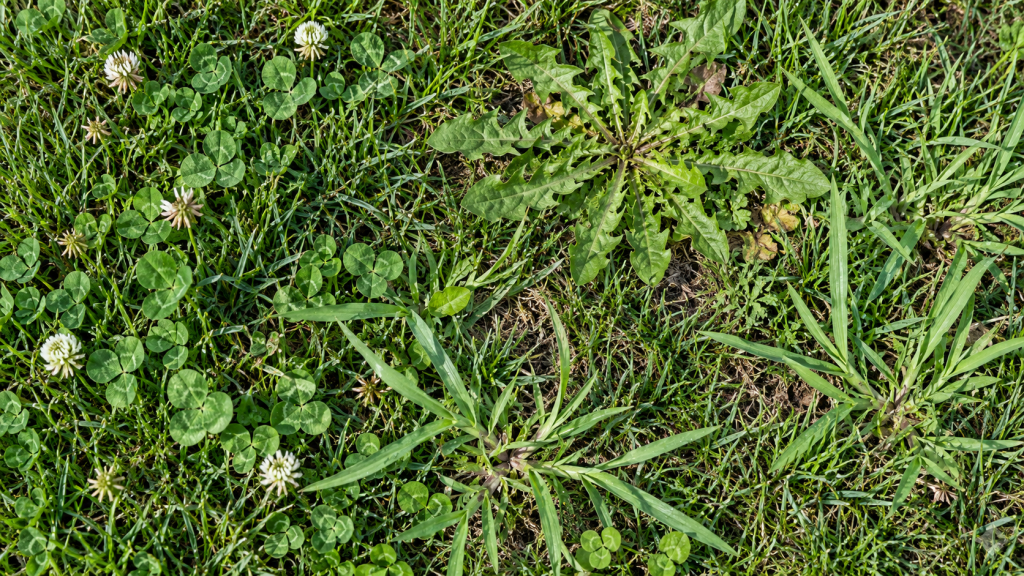
You cannot control a weed you cannot identify. The broadleaf weed killer that wipes out dandelions does nothing to crabgrass. The pre-emergent that stops crabgrass will not touch nutsedge. Pulling a weed by hand works for some species and makes others spread. So the first step in any weed problem is correct identification – and that is exactly what most homeowners skip.
This guide covers the 15 most common lawn weeds in New England, organized by category (broadleaf, grassy, and sedge), with clear identification features, what each weed signals about your lawn, and how to control it. Every weed here is one we regularly see across Haverhill, the Merrimack Valley, and Massachusetts lawns.
| Quick answer New England lawn weeds fall into three groups that each need different control: broadleaf weeds (dandelion, clover, plantain, ground ivy) are killed by broadleaf herbicides like 2,4-D; grassy weeds (crabgrass, foxtail, annual bluegrass) need pre-emergent prevention or grass-specific herbicides; and sedges (nutsedge) need specialty sedge herbicides. The best long-term weed control is a thick, healthy lawn – weeds invade thin, stressed turf. |
What you will learn in this guide
- The 3 weed categories and why they matter
- Broadleaf weeds (7 common New England types)
- Grassy weeds (5 common types)
- Sedges (nutsedge)
- What each weed signals about your lawn
- Quick identification reference table
- How to control weeds by category
- The best long-term weed prevention
- Frequently asked questions
The 3 weed categories and why they matter
Every lawn weed falls into one of three botanical categories, and the category determines how you control it. Misidentifying the category is why so many weed treatments fail.
- Broadleaf weeds. Wide, flat leaves that look obviously different from grass. Examples: dandelion, clover, plantain, ground ivy. Controlled by selective broadleaf herbicides (2,4-D, dicamba, MCPP) that kill broadleaf plants without harming grass.
- Grassy weeds. Look like grass but grow differently – coarser, faster, or lighter colored than your turf. Examples: crabgrass, foxtail, annual bluegrass. Hardest to control because they are botanically similar to your lawn. Best handled with pre-emergent prevention.
- Grass-like but with triangular stems (“sedges have edges”). Thrive in wet, poorly drained areas. Example: yellow nutsedge. Need specialty sedge-specific herbicides – broadleaf and grassy weed products do not work.
Broadleaf weeds (7 common New England types)
1. Dandelion (Taraxacum officinale)
| Type | Broadleaf perennial |
| Life cycle | Perennial – comes back every year from a deep taproot |
| How to identify | Bright yellow flowers in spring, turning to white puffball seed heads. Jagged toothed leaves in a flat rosette. Deep single taproot. |
| Where it shows up | Everywhere – sun or part shade, any soil. Most common New England lawn weed. |
| What it signals | Thin turf and bare soil that let seeds establish. |
| How to control | Spot-treat with broadleaf herbicide (2,4-D based) in fall for best results, or dig out the entire taproot. Pulling without the whole root just makes it regrow. |
2. White clover (Trifolium repens)
| Type | Broadleaf perennial |
| Life cycle | Perennial – spreads by creeping stems (stolons) |
| How to identify | Three round leaflets (occasionally four), often with a pale V-shaped mark. Small white to pinkish ball-shaped flowers that attract bees. |
| Where it shows up | Low-nitrogen lawns, sunny areas. Spreads in patches. |
| What it signals | Low soil nitrogen. Clover fixes its own nitrogen so it outcompetes grass in underfed lawns. Its presence often means the lawn needs fertilizer. |
| How to control | Fertilize the lawn (raising nitrogen makes grass outcompete clover), then spot-treat with a broadleaf herbicide containing dicamba or clopyralid. 2,4-D alone is weak on clover. |
3. Broadleaf plantain (Plantago major)
| Type | Broadleaf perennial |
| Life cycle | Perennial |
| How to identify | Oval, ribbed leaves in a flat rosette. Tall, narrow seed spikes rising from the center. Leaves have prominent parallel veins. |
| Where it shows up | Compacted soil, high-traffic areas, path edges. |
| What it signals | Soil compaction. Plantain thrives where soil is packed hard. Its presence is a strong signal that the lawn needs aeration. |
| How to control | Broadleaf herbicide (2,4-D). Address the root cause with core aeration – plantain keeps coming back in compacted soil regardless of spraying. |
4. Ground ivy / Creeping Charlie (Glechoma hederacea)
| Type | Broadleaf perennial |
| Life cycle | Perennial – aggressive creeper |
| How to identify | Round, scalloped leaves on square stems (mint family). Small purple funnel-shaped flowers in spring. Minty smell when crushed. Spreads flat across the ground. |
| Where it shows up | Shady, moist areas. Under trees and along north-facing edges. |
| What it signals | Too much shade and moisture for healthy grass. Grass thins in shade and ground ivy fills the gap. |
| How to control | One of the hardest broadleaf weeds to kill. Needs a herbicide with dicamba, applied in fall. Multiple applications usually required. Improve drainage and reduce shade where possible. |
5. Oxalis / Yellow woodsorrel (Oxalis stricta)
| Type | Broadleaf perennial (behaves like annual in cold climates) |
| Life cycle | Perennial to annual |
| How to identify | Looks like clover but with heart-shaped leaflets (not round). Small yellow 5-petal flowers. Seed pods shaped like tiny okra that burst when touched. |
| Where it shows up | Thin lawns, garden edges, sunny to part-shade areas. |
| What it signals | Thin, stressed turf. Opportunistic in bare spots. |
| How to control | Broadleaf herbicide with multiple active ingredients (2,4-D plus dicamba plus MCPP). Single-ingredient products often fail. Fall application works best. |
6. Common chickweed (Stellaria media)
| Type | Broadleaf annual (winter annual) |
| Life cycle | Winter annual – germinates in fall, grows through winter, flowers in spring |
| How to identify | Small, pointed oval leaves on low, spreading stems. Tiny white star-shaped flowers. Forms dense mats in cool weather. |
| Where it shows up | Cool, moist, shady areas. Most visible early spring. |
| What it signals | Moist, cool, shaded conditions. Often appears in fall-thin lawns. |
| How to control | Broadleaf herbicide in fall or early spring while actively growing. A fall pre-emergent can prevent the winter-annual germination. |
7. Creeping buttercup (Ranunculus repens)
| Type | Broadleaf perennial |
| Life cycle | Perennial – spreads by runners |
| How to identify | Glossy, deeply divided three-part leaves often with pale spots. Bright yellow 5-petal shiny flowers. Spreads by above-ground runners. |
| Where it shows up | Wet, poorly drained areas. Low spots that hold water. |
| What it signals | Poor drainage and waterlogged soil. A strong signal the lawn has a drainage problem. |
| How to control | Broadleaf herbicide with dicamba. Fix the underlying drainage – buttercup keeps returning in wet soil. Core aeration helps water penetration. |
Grassy weeds (5 common types)
8. Crabgrass (Digitaria species)
| Type | Grassy annual |
| Life cycle | Summer annual – germinates in spring, dies at first frost, drops thousands of seeds |
| How to identify | Light green, coarse blades. Grows low and spreads outward in a star or crab-leg pattern from a central point. Fast-growing in summer heat. |
| Where it shows up | Sunny areas, lawn edges near pavement (heat), thin turf. |
| What it signals | Thin turf and bare soil in summer. Crabgrass invades gaps that thick lawns would prevent. |
| How to control | Prevention is the key – apply pre-emergent in spring (see our crabgrass timing guide). Once established, use quinclorac post-emergent while plants are small. Best long-term fix: thicken the lawn. |
9. Yellow foxtail (Setaria pumila)
| Type | Grassy annual |
| Life cycle | Summer annual |
| How to identify | Distinctive fuzzy, cylindrical seed head that looks like a fox tail or bottle brush. Coarse blades with a twist. Grows upright. |
| Where it shows up | Sunny, thin lawns and disturbed soil. |
| What it signals | Thin turf, similar to crabgrass. |
| How to control | Same as crabgrass – spring pre-emergent prevents it; quinclorac controls young plants. Thicken the lawn to prevent recurrence. |
10. Annual bluegrass / Poa annua (Poa annua)
| Type | Grassy annual |
| Life cycle | Winter annual – germinates in fall, most visible spring |
| How to identify | Light green, fine blades – lighter than surrounding turf. Produces distinctive whitish seed heads even when mowed short. Grows in clumps. |
| Where it shows up | Compacted, moist areas, shady spots, edges. |
| What it signals | Compaction and excess moisture. Common in overwatered or poorly drained lawns. |
| How to control | Hard to control selectively since it is a grass. Fall pre-emergent helps prevent germination. Improve drainage and reduce compaction with aeration. Overseed thin areas to crowd it out. |
11. Quackgrass (Elymus repens)
| Type | Grassy perennial |
| Life cycle | Perennial – spreads aggressively by underground rhizomes |
| How to identify | Coarse, blue-green blades, wider than typical lawn grass. Grows faster and taller than turf. Clasping leaf structure where it wraps the stem. |
| Where it shows up | Anywhere – very aggressive. Field edges, gardens, lawns. |
| What it signals | Not a soil indicator – just an aggressive invader. |
| How to control | Very difficult. No selective herbicide kills quackgrass without killing your lawn grass. Small patches: spot-treat with glyphosate (kills everything), then reseed. Prevention through thick turf. |
12. Nimblewill (Muhlenbergia schreberi)
| Type | Grassy perennial |
| Life cycle | Perennial – dormant and brown in winter, green in summer |
| How to identify | Fine, wiry, gray-green blades. Forms patches that turn brown/straw-colored in fall earlier than surrounding lawn. Spreads by stolons. |
| Where it shows up | Shady, moist areas. Common under trees. |
| What it signals | Shade and moisture. Fills in where turf is thin from lack of sun. |
| How to control | Difficult. Mesotrione (Tenacity) provides some selective control over multiple applications. Otherwise spot-treat with glyphosate and reseed with shade-tolerant fine fescue. |
Sedges
13. Yellow nutsedge (Cyperus esculentus)
| Type | Sedge perennial |
| Life cycle | Perennial – spreads by underground tubers (nutlets) |
| How to identify | Looks like grass but grows faster and is lighter yellow-green. Triangular stems (roll one between your fingers – it has edges, not round like grass). Grows taller than the lawn within days of mowing. |
| Where it shows up | Wet, poorly drained areas. Low spots, near downspouts, irrigation-heavy zones. |
| What it signals | Poor drainage and excess moisture. Strong signal the area stays too wet. |
| How to control | Broadleaf and grassy weed killers do NOT work on sedges. Use a sedge-specific herbicide (halosulfuron / Sedgehammer). Fix drainage – nutsedge keeps returning in wet soil. Do not pull it, which leaves tubers behind that resprout. |
Two more to know
14. Wild violet (Viola sororia)
| Type | Broadleaf perennial |
| Life cycle | Perennial – waxy leaves resist herbicide |
| How to identify | Heart-shaped leaves, purple (sometimes white) 5-petal flowers in spring. Waxy leaf surface. Grows in clumps. |
| Where it shows up | Shady, moist areas. Under trees, north sides. |
| What it signals | Shade and moisture where grass struggles. |
| How to control | One of the most stubborn lawn weeds. Waxy leaves shed most herbicides. Needs triclopyr-based products applied in fall, often multiple years. Persistence required. |
15. Black medic (Medicago lupulina)
| Type | Broadleaf annual |
| Life cycle | Summer annual |
| How to identify | Clover-like three leaflets but with a small tooth at the leaf tip and the center leaflet on a short stalk. Small yellow flower clusters. Low, spreading habit. |
| Where it shows up | Dry, low-nitrogen, compacted soil. |
| What it signals | Low nitrogen and compaction. Like clover, black medic fixes its own nitrogen and thrives in underfed lawns. |
| How to control | Fertilize to boost grass, then broadleaf herbicide with dicamba. Address compaction with aeration. |
Quick identification reference table
| Weed | Category | Key ID feature | Signals |
| Dandelion | Broadleaf | Yellow flower, toothed rosette, taproot | Thin turf |
| White clover | Broadleaf | 3 round leaflets, white flowers | Low nitrogen |
| Plantain | Broadleaf | Ribbed oval leaves, seed spikes | Compaction |
| Ground ivy | Broadleaf | Scalloped leaves, square stems, minty | Shade + moisture |
| Oxalis | Broadleaf | Heart-shaped leaflets, yellow flowers | Thin turf |
| Chickweed | Broadleaf | Small oval leaves, white star flowers | Cool moist shade |
| Creeping buttercup | Broadleaf | Glossy divided leaves, shiny yellow flower | Poor drainage |
| Crabgrass | Grassy | Star/crab spreading pattern, light green | Thin summer turf |
| Yellow foxtail | Grassy | Fuzzy bottle-brush seed head | Thin turf |
| Annual bluegrass | Grassy | Light green, white seed heads when mowed | Compaction + moisture |
| Quackgrass | Grassy | Coarse blue-green, rhizomes | Aggressive invader |
| Nimblewill | Grassy | Wiry gray-green, browns early in fall | Shade + moisture |
| Yellow nutsedge | Sedge | Triangular stem, fast growth, yellow-green | Poor drainage |
| Wild violet | Broadleaf | Heart-shaped leaves, purple flowers, waxy | Shade + moisture |
| Black medic | Broadleaf | Clover-like with tooth, yellow flowers | Low nitrogen + compaction |
What your weeds signal about your lawn
Weeds are not random – they colonize conditions where grass struggles. Reading the weeds tells you what is wrong with the lawn, and fixing the underlying condition is more effective than spraying year after year.
- Clover, black medic (nitrogen fixers): Low soil nitrogen. Fertilize on a proper schedule.
- Plantain, annual bluegrass, prostrate weeds: Soil compaction. Aerate.
- Nutsedge, buttercup, ground ivy: Excess moisture and poor drainage. Fix grading and drainage; aerate.
- Ground ivy, violets, nimblewill, chickweed: Too much shade. Prune trees to let light in or switch to shade-tolerant fine fescue.
- Crabgrass, foxtail, dandelion, oxalis: Thin turf and bare soil. Overseed to thicken the lawn.
For the nitrogen and compaction issues specifically, see the New England lawn fertilizer schedule and when to aerate your lawn in Massachusetts.
How to control weeds by category
Broadleaf weeds
Use a selective broadleaf herbicide – one that kills broadleaf plants without harming grass. Look for products containing 2,4-D, dicamba, MCPP, or triclopyr (three-way and four-way products handle more species). Fall application (September to October) is far more effective than spring, because perennial weeds are moving nutrients to their roots in fall and carry the herbicide down with them.
Grassy weeds
Prevention beats cure. Apply a pre-emergent in spring to stop annual grassy weeds (crabgrass, foxtail) before they germinate – see our crabgrass preventer timing guide. For weeds already up, quinclorac controls young crabgrass and foxtail. Perennial grassy weeds (quackgrass, nimblewill) usually require spot-treatment with non-selective glyphosate and reseeding, since no selective herbicide separates them from lawn grass.
Sedges
Sedges need a sedge-specific herbicide – halosulfuron (Sedgehammer) is the standard. Broadleaf and grassy weed killers do nothing to sedges. Just as important, fix the drainage problem that let nutsedge establish, or it returns every year.
Timing note for Massachusetts
Do not apply any weed control to newly seeded lawns until the new grass has been mowed at least 3 times. And do not overseed right after applying broadleaf herbicide – most products require a 3 to 4 week wait before seeding. See can you overseed and apply crabgrass preventer at the same time for the full interaction.
The best long-term weed prevention: a thick lawn
Every weed in this guide has the same core requirement: an opening. Bare soil, thin turf, a gap in the canopy. A dense, healthy lawn shades the soil surface so weed seeds never get the light they need to germinate, and it physically crowds out invaders. This is why the most effective weed control program is not a herbicide schedule – it is a thick-lawn program.
The four pillars of a weed-resistant lawn:
- Proper fertilization. A well-fed lawn grows dense. See the New England fertilizer schedule.
- Annual aeration and overseeding. Relieves compaction and fills thin areas. See when to aerate and how to overseed.
- Correct mowing height. Mow at 3 to 3.5 inches. Taller grass shades out weed seeds. Never scalp.
- Deep, infrequent watering. Encourages deep grass roots that outcompete shallow-rooted weeds. See how long should you water your lawn.
Frequently asked questions
What are the most common lawn weeds in New England?
Dandelion, white clover, broadleaf plantain, crabgrass, and yellow nutsedge are the five most common across Massachusetts and New England lawns. Ground ivy, wild violet, and annual bluegrass are also frequent, especially in shaded or moist areas.
How do I identify a weed in my lawn?
Start by category: broadleaf (wide flat leaves obviously different from grass), grassy (looks like grass but coarser or lighter), or sedge (grass-like with triangular stems). Then match the specific ID features – leaf shape, flower color, growth pattern – to the descriptions in this guide.
What is the difference between broadleaf and grassy weeds?
Broadleaf weeds have wide, flat leaves and are killed by selective broadleaf herbicides (2,4-D, dicamba) that spare grass. Grassy weeds look like grass and cannot be selectively killed the same way, so they need pre-emergent prevention or non-selective spot treatment.
How do I get rid of clover in my lawn?
Clover signals low nitrogen. First fertilize the lawn – raising nitrogen helps grass outcompete clover. Then spot-treat with a broadleaf herbicide containing dicamba or clopyralid (2,4-D alone is weak on clover). Fall application works best.
What weed looks like grass but grows faster?
Most likely yellow nutsedge (triangular stem, yellow-green, shoots up days after mowing) or crabgrass (spreads in a star pattern, light green). Roll the stem between your fingers – if it is triangular with edges, it is nutsedge, which needs a specialty herbicide.
Do weeds mean my soil is bad?
Often yes – specific weeds signal specific problems. Clover means low nitrogen, plantain means compaction, nutsedge means poor drainage, ground ivy means too much shade. Fixing the underlying condition prevents the weed better than repeated spraying.
When is the best time to kill lawn weeds in Massachusetts?
Fall (September to October) for broadleaf perennial weeds – they move nutrients to their roots and carry herbicide down with them. Spring for pre-emergent to prevent annual grassy weeds like crabgrass. Summer is the worst time for most weed control.
Can I pull weeds instead of using herbicide?
For some weeds, yes. Dandelions can be dug out if you get the whole taproot. But pulling makes some weeds worse – nutsedge leaves tubers behind that resprout, and quackgrass regrows from rhizome fragments. Know the weed before pulling.
Why do I keep getting the same weeds every year?
Because the underlying condition that favors them has not changed. If your soil stays compacted, plantain returns. If it stays wet, nutsedge returns. Spraying treats the symptom; fixing soil, drainage, shade, or fertility treats the cause.
What is the best way to prevent lawn weeds?
A thick, healthy lawn. Dense turf shades the soil so weed seeds cannot germinate and physically crowds out invaders. Proper fertilization, annual aeration and overseeding, correct mowing height (3 to 3.5 inches), and deep infrequent watering do more for weed control than any herbicide.
Get professional weed control in Haverhill
Identifying a weed is step one. Getting rid of it – and keeping it gone – takes the right product, the right timing, and a lawn healthy enough to resist reinvasion. Stateline LawnCare has been building thick, weed-resistant lawns across Haverhill and the Merrimack Valley since 2002. We handle aeration, overseeding, and fertilization programs that address the root causes weeds exploit.
Learn more about our core aeration and overseeding services or request a free lawn assessment and we will identify what is growing in your lawn and build a plan to fix it.


