
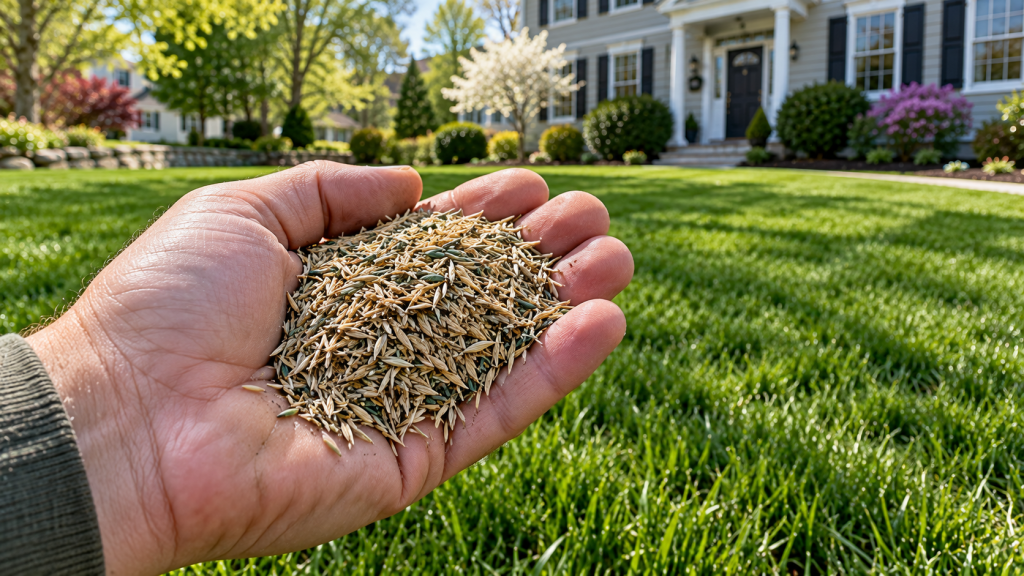
If you have ever walked into a Home Depot in Haverhill and stared at 20 different bags of grass seed trying to figure out which one is right for your lawn, you are not alone. Retail seed shelves are a maze of blends, brand names, and marketing claims, most of which do not tell you what you actually need to know: which grass species are in the bag, whether they suit New England conditions, and whether they match the sun, shade, and traffic your specific yard gets.
This guide covers the four cool-season grass species that actually work in Massachusetts, the blends that combine their strengths, how to match seed to your sun and traffic conditions, how to read a seed label properly, what to pay, and which brands are worth buying at retail in New England. It applies to lawns from Haverhill through the Merrimack Valley and across Massachusetts and southern New Hampshire.
| Quick answer The best grass seed for most Massachusetts lawns is a certified 3-way blend of turf-type tall fescue (50 to 70 percent), Kentucky bluegrass (20 to 30 percent), and perennial ryegrass (10 to 20 percent). This gives you drought tolerance from the fescue, spreading recovery from the bluegrass, and fast establishment from the ryegrass. For shaded lawns, substitute fine fescue for tall fescue. Buy certified seed with an NTEP-tested variety list on the label – avoid bags labeled generic “Kentucky Bluegrass Blend” without variety names. |
What you will learn in this guide
- Why Massachusetts is cool-season grass country
- The 4 cool-season species that grow in New England
- Sun / shade / traffic decision matrix
- Recommended blends for typical Massachusetts lawn conditions
- How to read a grass seed label (what actually matters)
- Seeding rates – pounds per 1,000 sq ft
- Recommended brands available in Massachusetts retail
- When to seed in Massachusetts (fall vs spring)
- Cost expectations
- The 7 grass seed buying mistakes to avoid
- Frequently asked questions
Why Massachusetts is cool-season grass country
The United States is divided into three lawn zones based on climate: cool-season in the north, warm-season in the south, and a transition zone in the middle. Massachusetts sits firmly in the cool-season zone, along with all of New England, New York, most of the upper Midwest, and the Pacific Northwest.
Cool-season grasses do their best growing in spring and fall, when air is between 60 and 75 degrees F. They slow down in summer heat (often going dormant during drought) and stop growing entirely when soil temperatures drop below 45 degrees F. Warm-season species like Bermuda grass, zoysia, and St. Augustine that dominate southern lawns will not survive a Massachusetts winter.
The four cool-season species that make sense for Massachusetts lawns are Kentucky bluegrass, perennial ryegrass, turf-type tall fescue, and fine fescue. Each has different strengths and weaknesses, and blending them produces a lawn that handles more conditions than any single species alone.
The 4 cool-season species that grow in Massachusetts
Kentucky bluegrass (Poa pratensis)
Kentucky bluegrass is the classic New England lawn grass – the deep green, fine-bladed turf that shows up in magazine covers and neighborhood postcards. It has been the dominant cool-season species in Massachusetts for over a century.
- Strengths: Beautiful deep color, fine leaf texture, self-repairing through rhizomes (underground stems that fill in bare spots), cold hardy, tolerates foot traffic once established.
- Weaknesses: Slow to establish (14 to 30 days germination), needs more water than tall fescue during summer, less drought tolerant, higher nitrogen requirement, more prone to thatch buildup, struggles in heavy shade.
- Best for: Sunny to partly sunny lawns with an irrigation system, homeowners who prioritize appearance and are willing to fertilize and water on a schedule.
Turf-type tall fescue (Festuca arundinacea)
Modern turf-type tall fescue is a completely different grass than the coarse pasture fescue your grandparents complained about. Today’s varieties (developed since the 1990s) have finer leaves, better color, and turf-quality density comparable to Kentucky bluegrass.
- Strengths: Deep root system (up to 3 feet down) gives excellent drought tolerance, handles compacted or clay-heavy soils, moderate shade tolerance, disease resistant, lower fertilizer requirement, thicker leaf blades resist wear from traffic.
- Weaknesses: Bunch-type growth means it does not spread to fill bare spots (need to reseed), coarser texture than KBG, seedling establishment can be spotty if not watered consistently.
- Best for: Most Massachusetts lawns as the primary component of a blend, especially clay-heavy Merrimack Valley soils, high-traffic lawns, and homeowners who want low-maintenance turf.
Perennial ryegrass (Lolium perenne)
Perennial ryegrass is the sports-field standard – fast to germinate, quick to establish, and tough under wear. In home lawns, it is used as a supporting species in blends rather than as the primary grass.
- Strengths: Fastest germination of any cool-season grass (5 to 10 days), tough leaf blade resists foot traffic and mowing, dark green color, disease resistant, works as a “nurse grass” that establishes quickly while slower species (KBG, TF) develop.
- Weaknesses: Bunch-type growth (does not spread), less cold hardy than KBG or fescue (can suffer winter kill in harsh Massachusetts winters), no drought tolerance, requires more mowing due to fast growth.
- Best for: 10 to 20 percent of a blend for fast cover and traffic tolerance. Rarely planted as a pure stand except on athletic fields.
Fine fescue (Festuca rubra, Festuca ovina, and others)
Fine fescue is actually a group of related species: creeping red fescue, chewings fescue, hard fescue, and sheep fescue. They all have very fine, needle-like leaf blades and share the same core strength: shade tolerance. Fine fescue is the only cool-season grass that reliably grows under mature tree canopies.
- Strengths: Excellent shade tolerance (grows under trees where nothing else will), low water requirement, low fertilizer requirement, cold hardy, fine texture looks great when established.
- Weaknesses: Poor traffic tolerance (crushes easily), slower to recover from wear, some varieties clump rather than spread, can look thin under heavy stress.
- Best for: Shaded areas under trees, low-maintenance zones, back yards with minimal foot traffic, mixed with tall fescue in transitional shade areas.
Sun / shade / traffic decision matrix
Use this table to match seed selection to the actual conditions of your lawn (or specific sections of your lawn – a front yard in full sun and a back yard under trees need different blends).
| Lawn Condition | Recommended Blend | Why |
| Full sun, average traffic | 60% turf-type tall fescue + 30% Kentucky bluegrass + 10% perennial ryegrass | Balanced 3-way. Fescue for drought, KBG for repair, ryegrass for fast cover. |
| Full sun, heavy traffic (kids, dogs) | 70% turf-type tall fescue + 20% Kentucky bluegrass + 10% perennial ryegrass | More fescue for wear tolerance and deep roots. |
| Full sun, irrigated, appearance priority | 70% Kentucky bluegrass + 20% turf-type tall fescue + 10% perennial ryegrass | KBG-heavy for looks, only viable if watering is consistent. |
| Part shade (4 to 6 hours sun) | 50% turf-type tall fescue + 30% fine fescue + 20% Kentucky bluegrass | Fine fescue handles shade edges, KBG fills sunnier spots. |
| Heavy shade (under trees) | 80% fine fescue blend (creeping red + chewings + hard) + 20% turf-type tall fescue | Fine fescue is the only species that reliably grows in deep shade. |
| Clay-heavy soil | 80% turf-type tall fescue + 20% Kentucky bluegrass | Deep TTTF roots break through clay layers over time. |
| Sandy or dry soil | 70% turf-type tall fescue + 20% fine fescue + 10% Kentucky bluegrass | Both fescues tolerate drought better than KBG. |
| New construction (bare soil) | 60% turf-type tall fescue + 20% perennial ryegrass + 20% Kentucky bluegrass | Higher ryegrass for fast erosion control while slower species establish. |
| Overseeding thin existing lawn | Match dominant species already present + add 20% perennial ryegrass | Blend into what is there; ryegrass for fast visible improvement. |
How to read a grass seed label (what actually matters)
The front of a seed bag is marketing. The label on the back is where the actual product information lives – and reading it correctly tells you whether you are buying a quality mix or a bag of filler.
What to look for on the label
- Named cultivars, not generic species. A quality label lists specific variety names like “Rebel IV tall fescue” or “Blueberry Kentucky bluegrass,” not just “Kentucky bluegrass” or “tall fescue blend.” Named varieties have been tested and improved; unnamed generics are commodity stock.
- NTEP-tested varieties. The National Turfgrass Evaluation Program (NTEP) tests grass varieties under standardized conditions and publishes performance data. Reputable seed companies use NTEP-tested varieties and mention it on the label or their website.
- Purity percentage (should be 95% or higher). Purity means how much of the bag is actual desirable seed vs weed seed, other crop seed, and inert matter (chaff, dust). Quality bags run 98 to 99 percent pure.
- Germination percentage (should be 85% or higher). This is how much of the seed will actually germinate under proper conditions. Fresh, high-quality seed germinates 90+ percent; old or low-quality seed can drop below 70 percent.
- Weed seed percentage (should be under 0.5%). Some weed seed is inevitable, but quality bags stay well under 1 percent. Cheap bags often contain 1 to 3 percent weed seed – which means you are literally planting weeds.
- “Noxious weed” line (should read “NONE FOUND”). Noxious weeds are legally regulated invasive species. A quality bag will say “None Found” here. If any noxious weeds are listed, put the bag back.
- Test date within the last 12 months. Germination declines with age. Look for a test date within the past year – seed from two years ago has significantly reduced germination even if sealed.
| The “cheap seed” trap A $15 bag that covers 5,000 sq ft usually contains 30-40% inert filler, 5-10% weed seed, and commodity grass varieties with 70-80% germination. A $40 bag covers the same area with 98% purity, 0.1% weed seed, and named NTEP varieties. You get 3 times the actual grass for less than 3 times the money, and you avoid planting weeds. Buy quality seed. |
Seeding rates: pounds per 1,000 square feet
Applying the right amount of seed matters. Too little produces a thin, patchy lawn. Too much causes seedlings to compete with each other and die off. These rates are for standard establishment; overseeding an existing lawn uses roughly half the rate.
| Grass Type | New Lawn (lbs / 1,000 sq ft) | Overseeding (lbs / 1,000 sq ft) |
| Kentucky bluegrass (pure) | 2 to 3 lbs | 1 to 2 lbs |
| Turf-type tall fescue (pure) | 6 to 10 lbs | 4 to 6 lbs |
| Perennial ryegrass (pure) | 6 to 9 lbs | 3 to 5 lbs |
| Fine fescue (pure) | 4 to 5 lbs | 2 to 3 lbs |
| 3-way blend (KBG/TTTF/PR) | 5 to 7 lbs | 3 to 4 lbs |
| Sun/shade mix (with fine fescue) | 4 to 6 lbs | 2 to 3 lbs |
Recommended brands available in Massachusetts
Retail brands (Home Depot, Lowes, hardware stores)
- Scotts Turf Builder Sun and Shade Mix. Contains ryegrass, KBG, and fescue. Widely available. Decent quality for a retail bag, though the fescue percentage varies year to year. Look at the label to confirm current composition.
- Jonathan Green Black Beauty. New England brand with strong distribution in Massachusetts. The “Original” mix is heavy on turf-type tall fescue with named varieties. Strong choice for MA lawns.
- Vigoro (Home Depot store brand). Budget option. Quality varies by mix. Read the label – some Vigoro bags are decent, others are filler-heavy.
Specialty brands (independent garden centers, online)
- Pearl’s Premium. Massachusetts-based (Wayland, MA) low-maintenance seed developed specifically for New England. Uses tall fescues and fine fescues, promotes drought tolerance and reduced mowing. Premium price, strong regional fit.
- Preferred Seed (New York). Northeast distributor, quality varieties, sold through independent garden centers and online. Strong for named-cultivar KBG and tall fescue blends.
- SiteOne Landscape Supply. Professional supplier with locations across Massachusetts. Sells contractor-grade seed to homeowners for slightly higher-than-retail prices but with much better varieties. Ask for Lesco brand blends.
What to avoid
- “Contractor mix” bags for under $2 per pound. Almost always heavy on annual ryegrass (dies in one year) or coarse pasture-type tall fescue. Cheap upfront, expensive when you have to reseed the whole area next year.
- Bags without variety names on the label. If the label says “Kentucky bluegrass” without naming which variety, you are buying commodity seed. Not necessarily bad, but not premium quality.
- Old bags on clearance. Grass seed germination declines about 10 percent per year after the test date on the label. A 2-year-old bag on clearance might have 60 percent germination – not a bargain.
When to seed grass in Massachusetts
Fall (early September) – the primary window
For Massachusetts specifically, early to mid-September is the best time of year to seed. Soil is still warm from summer (aiding germination), air is cooling (reducing seedling stress), weed pressure is dropping (crabgrass and other summer annuals have stopped germinating), and there are 6 to 8 weeks of active growing conditions before winter dormancy. Pair seeding with core aeration for best results – see the when to aerate your lawn in Massachusetts guide for the full timing rationale.
Spring (mid-April to early May) – secondary window
Spring seeding works but has real drawbacks in Massachusetts: cold soil slows germination, weed pressure (especially crabgrass) is at its highest, and new grass has only 4 to 6 weeks to establish before summer heat sets in. Spring seeding also conflicts with crabgrass pre-emergent timing – you have to pick one or the other unless you use a seed-safe product like Tenacity.
Summer (June through mid-August) – avoid
Do not seed in Massachusetts summer. Cool-season grass seedlings cannot survive the heat and drought of a New England July. Any grass that does germinate dies before establishing.
Cost expectations
Grass seed pricing varies widely based on quality. These ranges reflect typical Massachusetts retail prices.
| Quality Tier | Price per lb | Cost to seed 5,000 sq ft | What you get |
| Budget | $3 to $5 | $75 to $175 (new lawn) | Cheap contractor mix, commodity varieties, often heavy on annual ryegrass |
| Standard retail | $5 to $8 | $125 to $280 | Scotts, Jonathan Green Black Beauty, Vigoro – reasonable quality, named varieties |
| Premium | $8 to $15 | $200 to $525 | Pearl’s Premium, top NTEP-rated cultivars, low weed seed, professional-grade |
| Contractor / professional | $4 to $8 (bulk) | $100 to $280 (5+ acres) | Lesco through SiteOne, quality varieties at bulk prices |
The 7 grass seed buying mistakes to avoid
Mistake 1: Buying by front label only
The front of the bag is marketing. Always flip it over and read the ingredient panel and analysis on the back. A pretty bag can hide commodity seed with 5% weed content.
Mistake 2: Choosing warm-season grass (Bermuda, zoysia)
If you see Bermuda, zoysia, St. Augustine, or centipede on a bag in Massachusetts, put it back. Warm-season grasses do not survive New England winters. They are for the South.
Mistake 3: Ignoring shade requirements
A “sun and shade mix” is only appropriate for partial shade (4 to 6 hours of sun). Deep shade under mature trees needs a fine fescue-dominant mix. Sunny lawns benefit from KBG-heavy or TTTF-heavy blends without much fine fescue.
Mistake 4: Using old seed
Check the test date on the label. Seed loses about 10 percent germination per year. A bag tested more than 12 months ago has noticeably reduced performance and is not usually worth the small discount.
Mistake 5: Buying “annual ryegrass” thinking it is perennial
Annual ryegrass (Lolium multiflorum) dies at the end of one growing season. It is often used as filler in cheap mixes to make them look fuller. You want PERENNIAL ryegrass (Lolium perenne), which persists year after year.
Mistake 6: Skipping variety names
A bag that lists “Kentucky bluegrass” without a variety name is commodity seed. Bags that list “NuGlade KBG” or “Blueberry KBG” are naming NTEP-tested varieties with published performance data. Named varieties cost slightly more and produce significantly better lawns.
Mistake 7: Under-seeding to save money
Half the recommended rate produces less than half the lawn – patchy establishment with lots of bare soil where weeds move in. Buy enough seed for the actual coverage rate. If cost is a concern, buy quality seed at the right rate for a smaller area rather than cheap seed at half rate over a big one.
Frequently asked questions
What is the best grass seed for Massachusetts?
A certified 3-way blend of turf-type tall fescue (50 to 70 percent), Kentucky bluegrass (20 to 30 percent), and perennial ryegrass (10 to 20 percent) works for most Massachusetts lawns. For shaded areas, substitute fine fescue for the tall fescue.
Can I plant Kentucky bluegrass in Massachusetts?
Yes – Kentucky bluegrass is the classic New England lawn grass and grows well throughout Massachusetts. It requires more water and fertilizer than tall fescue, and does not tolerate heavy shade, but it produces the deep green color and fine texture most homeowners want.
What grass grows best in Massachusetts clay soil?
Turf-type tall fescue. Its deep root system (down to 3 feet) breaks through clay layers and accesses deeper moisture, making it more drought tolerant than KBG on clay-heavy Merrimack Valley soils.
What is the best shade grass for Massachusetts?
Fine fescue – specifically a blend of creeping red fescue, chewings fescue, and hard fescue. It is the only cool-season grass that reliably grows under mature tree canopies. Mix with some turf-type tall fescue for transitional shade edges.
How much grass seed do I need for my lawn?
For a new lawn: 5 to 7 pounds of a 3-way blend per 1,000 sq ft. For overseeding an existing lawn: 3 to 4 pounds per 1,000 sq ft. Measure your lawn area accurately and buy enough seed for the actual rate – under-seeding produces patchy results.
When is the best time to plant grass seed in Massachusetts?
Early September is the primary window. Soil is still warm from summer, air is cooling, weed pressure is dropping, and there are 6 to 8 weeks before dormancy. Spring (mid-April to early May) is a secondary option but has more challenges (cold soil, weed pressure, crabgrass pre-emergent conflict).
Is Pearl’s Premium worth the price?
For homeowners who want a low-maintenance lawn that requires less watering, mowing, and fertilizing, Pearl’s Premium is worth the premium price. It is developed in Massachusetts specifically for New England conditions. For homeowners on a budget or with an irrigation system already installed, Jonathan Green Black Beauty or Scotts Turf Builder Sun and Shade give solid results at a lower cost per bag.
Can I mix different grass seeds together?
Yes – and most quality bags are already blends of 3 to 5 different varieties or species. If you buy pure species (100% tall fescue, 100% KBG), you can blend them yourself for a custom mix. Follow the sun/shade/traffic matrix in this guide for ratios.
Does Scotts Turf Builder grass seed work in Massachusetts?
Yes, Scotts Turf Builder Sun and Shade Mix works reasonably well in Massachusetts. The mix contains cool-season species appropriate for New England (KBG, ryegrass, fescue). Quality is decent for a retail bag though not as high as premium brands like Pearl’s Premium or professional-grade Lesco.
How long does grass seed take to germinate in Massachusetts?
Depends on species and soil temperature. Perennial ryegrass: 5 to 10 days. Turf-type tall fescue: 10 to 14 days. Kentucky bluegrass: 14 to 30 days (slowest). Fine fescue: 10 to 21 days. Blends germinate in waves – ryegrass first, then TTTF, then KBG last.
Book professional overseeding in Haverhill
Choosing the right seed is only half the job. Getting the seed into the ground correctly – proper seed-to-soil contact, watering discipline, aftercare – is the other half. Stateline LawnCare has been running fall aeration and overseeding programs across Haverhill and the Merrimack Valley since 2002. We use professional-grade seed blends matched to your specific lawn conditions and coordinate every step from soil prep through establishment.
Learn more about our overseeding service in Haverhill or request a free lawn assessment and we will recommend the right blend and process for your lawn.


